Contents
- 1 Convex Lens – Ray diagram, Image Formation, Table
- 1.1 Case 1. Image formed by a convex lens when the object is placed between optical centre and focus (Object between C and F’)
- 1.2 Case 2. When the object is placed at the focus of a convex lens (Object at F)
- 1.3 Case 3. When the object is between F and 2F (Object between f and 2f)
- 1.4 Case 4. When the object is at 2F’ (Object at 2f)
- 1.5 Case 5. When the object is beyond 2F’ (Object beyond 2f)
- 1.6 Case 6. When the object is at infinity
- 1.7 To Determine the Focal Length of a Convex Lens Quickly but Approximately
- 1.8 Uses of Convex Lenses
Advanced Physics Topics like quantum mechanics and relativity have revolutionized our understanding of the universe.
Convex Lens – Ray diagram, Image Formation, Table
The type of image formed by a convex lens depends on the position of the object in front of the lens. We can place the object at different positions (or distances) from a convex lens to get different types of images. We can place the object :
- between the optical centre (C) and focus (F’) (see Figure)
- at the focus (F’)
- between F’ and 2F’
- at 2F’
- beyond 2F’, and
- at infinity.

We will consider all these six positions one by one.
Case 1. Image formed by a convex lens when the object is placed between optical centre and focus (Object between C and F’)
In Figure we have a convex lens with optical centre C and two foci F and F’. The object AB has been placed between the optical centre C and focus F’ so that it is at a distance less than the focal length/of the convex lens. In other words, the object AB is within the focus of the convex lens. A ray of light AD starting from the top of the object and parallel to the axis, passes through the other focus F after refraction through the lens and goes in the direction DX. Another ray of light AC passing through the optical centre C of the lens goes straight in the direction CY.

The two refracted rays DX and CY diverge away from one another and, therefore, they cannot meet at a point on the right side to form a real image. We produce the refracted rays DX and CY backwards (to the left side) by dotted lines. They appear to meet at point A’ on the left side. Thus, A’ is the virtual image of point A of the object. To get the complete image of the object, we draw A’B’ perpendicular to the axis from point A’.
Thus, A’B’ is the complete image of object AB. When our eye looks into the lens from the right side, it appears as if the light rays are coming from A’ and B’ instead of A and B. Thus, A’B’ is the virtual image. It is erect, larger than the object and can be seen only by looking through the lens. It is formed on the same side of the lens as the object. From the above discussion we conclude that when the object is placed within the focus of a convex lens, the image formed is :
- behind the object (on the left side of lens),
- virtual and erect, and
- larger than the object (enlarged or magnified).
Figure explains the use of a convex lens as a magnifying glass (or simple microscope). It should be noted that to use a convex lens as a magnifying glass, the object to be viewed should be placed within its focus, so that a magnified and erect image of the object is obtained. That is, the object should be placed at

a distance less than the focal length of the convex lens. For example, if the focal length of a convex lens is 5 centimetres, then the object to be magnified with it should be kept at a distance of less than 5 centimetres from this convex lens. So, if we look at a comb through this convex lens (by keeping the comb within 5 centimetres from it), then the part of comb seen through the convex lens appears much bigger in size than it actually is (see Figure). We actually see the magnified image of the comb through the convex lens. Figure shows a convex lens being used as a magnifying glass to read the small print of a book.
Please note that smaller the focal length of a convex lens, greater will be its magnifying power. So, we should use a convex lens of short focal length as a magnifying glass. It will produce large magnification and hence the object will appear much bigger when seen through it. For example, a convex lens of 5 cm focal length will have a greater magnifying power than a convex lens of 50 cm focal length. So, we should use the convex lens having a shorter focal length of 5 cm as the magnifying glass. Thus, if we are given two convex lenses of focal lengths 5 cm and 50 cm respectively, then we should prefer to use the convex lens having 5 cm focal length as a magnifying glass (to see small things or read small letters of a dictionary).
Case 2. When the object is placed at the focus of a convex lens (Object at F)
By saying that the object is at the focus of a convex lens, we mean that the object is at a distance equal to the focal length f of the lens. Figure shows an object AB placed at the focus F’ of a convex lens. A parallel ray of light AD passes through the focus F after refraction and goes along the path DX. Another ray AC passing through the centre C of the lens goes straight in the direction CY. The two refracted rays DX and CY are parallel to one another. These parallel rays will intersect (or meet) at a far off distance to form an image ‘at infinity’. And since the image is formed at infinity, it is not possible to show it in our diagram. It will be real and inverted, and highly magnified or highly enlarged. From this discussion we conclude that when an object is placed at the focus of a convex lens, the image formed is :
- at infinity,
- real and inverted, and
- highly enlarged.
Suppose we have a convex lens of focal length 5 cm, then its focus (F’) will be at a distance of 5 cm from it. So, by saying that the object is placed at the focus of this convex lens, we mean that the object is placed at a distance of 5 cm from the convex Tens on its left side. In this case the convex lens converts the diverging rays of light coming from the object into a parallel beam of light rays which form an image at infinity (or very large distance).
Case 3. When the object is between F and 2F (Object between f and 2f)
By saying that the object is between F’ and 2F’, we mean that the object is at a distance greater than focal length f but less than twice the focal length 2f. So, whether we say that the object is between F’ and 2F’ or between/and 2f, it means the same thing.

Figure shows an object AB placed between F’ and 2F’ of a convex lens. A ray of light AD which is parallel to the principal axis passes through the focus F after refraction and goes in the direction DF (see Figure). Another ray of light AC passing through the centre C of the lens goes straight and meets the first refracted ray at point A’ on the right side of the lens. Thus, A’ is the real image of point A of the object.
Draw A’B’ perpendicular to the axis to get the complete image A’B’. If we place a screen at B’, we can receive the image A’B’ on the screen. It should be noted that the image is larger than the object (or magnified) and it is formed beyond IF on the right side of the convex lens. From this discussion we conclude that when an object is placed between F’ and IF’ in front of a convex lens, the image formed is :
- beyond 2F,
- real and inverted, and
- larger than the object (or magnified).
Figure shows how a convex lens is used as a projection lens for the purpose of projecting a magnified real image of a slide (or a film) on a screen. The slide (or film) is kept between F’ and IF’ of a convex lens and illuminated by a source of light (such as an electric lamp). A magnified image of the picture on the slide (or film) is produced on a screen placed on the other side of the convex lens.
Suppose we have a convex lens of 5 cm focal length, then its focus (F’) will be at a distance of 5 cm from it. So, by saying that the object is between F’ and 2F’ from this convex lens, we will mean that the object is between 5 cm and 2 × 5 = 10 cm from the convex lens on its left side. And by saying that the image is formed beyond 2F on the other side, we mean that the image is formed at a distance of more than 10 cm from convex lens on its right side.
Case 4. When the object is at 2F’ (Object at 2f)
By saying that the object is placed at 2F’, we mean that the object is at a distance equal to twice the focal length of the convex lens. In other words, the object is placed at a distance 2f from the convex lens. Figure shows an object AB placed at a distance 2f (twice the focal length), from a convex lens. A ray of light AD which is parallel to the principal axis passes through the focus F after refraction and goes in the direction DF (see Figure). Another ray of light AC passing through the optical centre C of the lens, goes straight and meets the first refracted ray at point A’, on the right side of the lens.

Thus, A’ is the real image of point A of the object. We draw A’B’ perpendicular to the axis to get the complete image A’B’. We find that the image A’B’ is formed at 2F, at a distance 2/on the right side of the convex lens. So, in this case, the object and its image are at equal distance (2f each) from the convex lens, but they are on opposite sides of the lens. Thus, when an object is placed at a distance 2f in front of a convex lens, then the image formed is :
- at a distance 2f on the other side of the lens,
- real and inverted, and
- of the same size as the object.
Suppose we have a convex lens of focal length 5 cm, then its focus (F’) will be at a distance of 5 cm from it. So, by saying that the object is at IF’ of this convex lens, we will mean that the object is at a distance of 2 × 5 = 10 cm from this convex lens on its left side. And by saying that the image is formed at 2F on the other side, we will mean that the image is formed at a distance of 2 × 5 = 10 cm from the convex lens on its right side.
Case 5. When the object is beyond 2F’ (Object beyond 2f)
Figure shows an object AB placed beyond 2f in front of a convex lens. To construct the ray diagram, we first take a ray of light AD parallel to the principal axis. After refraction, it will pass through focus F and go in the direction DF. A second ray of light AC, passing object 2F through the optical centre C will go straight in the direction CA’.
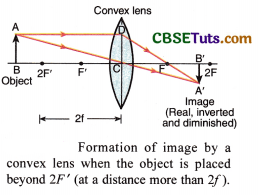
The two refracted rays meet at point A’, so A’ is the real image of point A of the object. To get the complete image, we draw A’B’ perpendicular to the axis. Thus, A’B’ is the complete image of the object AB. And it is formed between f and 2f on the other side of the lens. The image is real, inverted and smaller than the object. From the above discussion we conclude that when an object is placed beyond 2f in front of a convex lens, then the image formed is :
- between f and 2f on the other side of the lens,
- real and inverted, and
- smaller than the object (or diminished).
Figure shows the action of a simple camera lens in producing a small, real and inverted image of an object on the film. A simple camera has a convex lens in it. The object to be photographed is at a distance of more than twice the focal length of the convex lens. The convex lens forms a real, inverted and small image (diminished image) of the object on the film.
Suppose we have a convex lens of focal length 5 cm. Then its focus (F’) will be at a distance of 5 cm on its left side, and its 2F’ will be at a distance of 2 × 5 = 10 cm on the left side. So, by saying that the object is beyond IF’ of this convex lens, we will mean that the object is beyond 10 cm from convex lens on the left side. And by saying that the image is formed between F and 2F on the other side, we will mean that the image is formed at a distance between 5 cm and 10 cm from the convex lens on the right hand side of the lens.

Figure shows an actual picture of the formation of a real, inverted and diminished image by a convex lens of the filament of a lighted bulb on a screen.
Case 6. When the object is at infinity
When the object is at a considerable distance, we say that the object is at infinity. Suppose an object AB (in the form of an arrow pointing upwards) is at a considerable distance from a convex lens. Since the object is very far off from the lens, it has not been shown in Figure. Now, when the object is at infinity, then all the rays from a given point of the object, which are diverging in the beginning, become parallel to one another when they reach the lens after travelling a long distance. So, in Figure, we have two rays AD and AC coming from the same point A of the object. The incident rays AD and AC are parallel to one another but at an angle to the principal axis. The incident ray AD gets refracted along DX.
The second ray AC passing through the optical centre C of the lens goes straight along CY and meets the first refracted ray at A’. Thus, A’ is the real image of the top point A of the object. We draw A’B’ perpendicular to the axis from A’. Thus, A’B’ is the complete image of the object AB placed at infinity. It is clear from Figure, that the image is formed at the focus of the lens. It is real, inverted and much smaller than the object.

From this discussion we conclude that when an object is at infinity from a convex lens, then the image formed is :
- at the focus,
- real and inverted, and
- much smaller than the object (or highly diminished).
Figure represents the action of the objective lens of a telescope. Because in a telescope, the objective lens is a convex lens which forms a real, inverted and diminished image of the distant object at its focus. Please note that when the object kept at infinity in front of a convex lens is assumed to be a big arrow pointing upwards, then its image is formed at focus according to the ray-diagram shown in Figure. If, however, the object kept at infinity in front of a convex lens is round in shape (like the sun), then its image is formed at the focus according to the ray-diagram shown in Figure on page 231.
To Determine the Focal Length of a Convex Lens Quickly but Approximately
When the object is at infinity, the distance of image from the lens will be equal to the focal length of the lens. This fact is used to find out the focal length of a convex lens quickly but approximately. Let us see how this is done.
To determine the focal length of a convex lens, we put the convex lens in a holder (or stand) and keep it in front of a distant object like a window (or a tree), so that the rays coming from the window pass through it. A cardboard screen is put behind the lens. We change the distance of the screen from the convex lens until a clear inverted image of the window is formed on the screen.
Measure the distance of the screen from the lens with a scale. This distance will be the focal length of convex lens. For example, if the image of a distant window is formed at a distance of 20 cm from a convex lens, then the focal length of this convex lens will be 20 cm. And before we end this discussion, here is a summary of the images formed by a convex lens.
summary of the Images Formed by a Convex Lens

Uses of Convex Lenses
- Convex lenses are used in spectacles to correct the defect of vision called hypermetropia (or long-sightedness).
- Convex lens is used for making a simple camera.
- Convex lens is used as a magnifying glass (or magnifying lens) (by palmists, watchmakers, etc.).
- Convex lenses are used in making microscopes, telescopes and slide projectors (or film projectors). We will now solve some problems based on the formation of images by a convex lens.
Example Problem 1.
Where should an object be placed so that a real and inverted image of the same size is obtained by a convex lens ?
(a) at the focus of the lens.
(b) at twice the focal length.
(c) at infinity.
(d) between the optical centre of lens and its focus. (NCERT Book Question)
Answer.
(b) at twice the focal length.
Example Problem 2.
A convex lens has a focal length of 20 cm. Where should an object be placed in front of this convex lens so as to obtain an image which is real, inverted and same size as the object ? Draw the ray diagram to show the formation of image in this case. (NCERT Book Question)
Solution.
When the image formed by a convex lens is real, inverted and same size as the object, then the distance of the object from the lens is 2f(twice the focal length). Here,
Focal length, f = 20 cm
So, 2f = 2 × 20 cm
= 40 cm
Thus, the object should be placed at a distance of 40 cm in front of the convex lens. (Please draw the ray diagram yourself).
Example Problem 3.
An object is placed at the following distances from a convex lens of focal length 10 cm :
(a) 8 cm
(b) 15 cm
(c) 20 cm
(d) 25 cm
Which position of the object will produce :
(i) a diminished real image ?
(ii) a magnified real image ?
(iii) a magnified virtual image ?
(iv) an image of the same size as the object ?
Solution.
The focal length of this convex lens is 10 cm. This means that f = 10 cm.
(i) A diminished real image is formed by a convex lens when the object is beyond 2f, that is beyond 2 × 10 cm or beyond 20 cm. In this problem, the distance which is beyond 20 cm (or more than 20 cm) is 25 cm. Thus, 25 cm position of the object will produce a diminished real image.
(ii) A magnified real image is formed by a convex lens when the object is between f and 2f, that is between 10 cm and 20 cm. In this problem, the distance which is between 10 cm and 20 cm is 15 cm. So, 15 cm position of the object will produce a magnified real image.
(iii) A magnified virtual image is formed by a convex lens when the object is within focus, at a distance less than the focal length f or less than 10 cm. In this problem, the distance which is less than the focal length of 10 cm is 8 cm. Thus, 8 cm position of object will produce a magnified virtual image.
(iv) An image of the same size as the object is formed by a convex lens when the object is at 2f or twice the focal length from lens. Here 2f = 2 × 10 = 20 cm. So, the 20 cm position of the object will produce an image of the same size as the object.
If this question is asked in the examination, then the answer can just be written as :
(i) 25 cm
(ii) 15 cm
(iii) 8 cm
(iv) 20 cm
Example Problem 4.
Which of the following lens would you prefer to use while reading small letters found in a dictionary ?
(a) A convex lens of focal length 50 cm.
(b) A concave lens of focal length 50 cm.
(c) A convex lens of focal length 5 cm.
(d) A concave lens of focal length 5 cm. (NCERT Book Question)
Answer.
(c) A convex lens of focal length 5 cm.
Before we go further and discuss sign convention for lenses and the lens formula.