Contents
The study of Physics Topics involves the exploration of matter, energy, and the forces that govern the universe.
Motion of A Mass Suspended From A Rope Wrapped Around A Solid Cylinder
Let a solid cylinder of mass M and radius R is kept in such a way that it can rotate freely about its axis XX’ [Fig.(a)]. A mass m is suspended from a rope wrapped around the cylinder. It is then released from rest and for this, the cylinder begins to rotate about XX’.
Two forces act on the suspended mass m—
- its weight (vertically downward) and
- tension of the rope T (verti-cally upward).
i) Acceleration of the attached mass m: If the linear acceleration directed downward of mass m is a, then,
mg – T = ma

If the moment of inertia and angular acceleration about the axis of rotation are I and α respectively,

ii) Angular acceleration of the cylinder We know,
angular Acceleration \(=\frac{\text { linear acceleration }}{\text { radius }}\)
Hence, α = \(\frac{a}{R}\)
From equation (2) we get,
α = \(\frac{\frac{g}{R}}{1+\frac{I}{m R^2}}\)
iii) Tension of thread: From equation (1) we get,

The moment of inertia about the axis of the cylinder,
I = \(\frac{1}{2} M R^2\)
T = \(\frac{m g}{\frac{2 m R^2}{M R^2}+1}\) = \(\frac{m g}{1+\frac{2 m}{M}}\)
Mixed Motion
If a body undergoes translation and rotation simultaneously, then its motion is called a mixed motion. As for example, we will now discuss about the rolling of a body without slipping.
Downward rolling of a body without slipping on On inclined piano: Let a body (say a cylinder or a sphere) of mass M and radius R rolls down a plane without slipping inclined at an angle θ with the horizontal [Fig.]. We shall now find an expression for the linear acceleration (a) of the centre of mass of the body rolling down the plane. After that the value of friction will also be calculated.
i) Linear acceleration of the centre of mass of the body: Different forces with their components are shown in Fig. Applying Newton’s 2nd law of motion along the inclined plane, we get,
Mgsinθ – f = Ma ……. (1)
Here f is the static friction which generates torque and the angular acceleration. If the moment of inertia about an axis passing through the centre of mass are I and α respectively, then the torque acting on the body,
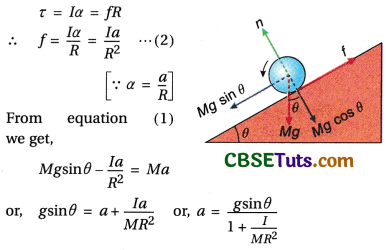
Special cases:
In case of solid cylinder, I = \(\frac{1}{2} M R^2\)
∴ a = \(\frac{g \sin \theta}{1+\frac{\frac{1}{2} M R^2}{M R^2}}\) = \(\frac{2}{3} g \sin \theta\)

ii) Friction acting on the body: From equation (2) we get,
f = \(\frac{I a}{R^2}\)
Special cases:

Comparison Between Linear And Rotational Motions
In the discussion of rotational motion, some physical quan-tities and numerical formulae, that we have already dealt with, are the rotational analogues of some physical quantities and numerical formulae of linear motion. These quantities and formulae are given below:


Numerical Examples
Example 1.
A particle of mass m Is projected at an angle of 45° with the horizontal. At the highest point of its motion (h), what will be its angular momentum with respect to the point of projection?
Solution:
At any point, the horizontal component of velocity of the particle = vx = vcos45° = \(\frac{v}{\sqrt{2}}\); the vertical velocity at the highest point = 0
If the time taken by the particle to reach the highest point is t, then
0 = vsin45° – gt
or, t = \(\frac{v}{\sqrt{2} g}\) [initial vertical velocity = vsin45°]
If the maximum height attained is h, then
h = vsin45° ᐧ t – \(\frac{1}{2} g t^2\) = \(\frac{v}{\sqrt{2}} \cdot \frac{v}{\sqrt{2} g}\) – \(\frac{1}{2} g \cdot \frac{v^2}{2 g^2}\)
= \(\frac{v^2}{2 g}-\frac{v^2}{4 g}\) = \(\frac{v^2}{4 g}\) ….. (2)
∴ Angular momentum of the particle with respect to the point of projection
= mvx × h = \(\frac{m v}{\sqrt{2}} \cdot \frac{v^2}{4 g}\) = \(\frac{m v^3}{4 \sqrt{2} g}\)
From equation (2) we get,
v2 = 4gh or, v = 2\(\sqrt{g h}\)
∴ The angular momentum of the particle about the point of projection
= \(\frac{m}{4 \sqrt{2} g} \cdot 8 \cdot(g h)^{3 / 2}\) = mg\(\sqrt{2 g h}\).
Example 2.
Initially a sphere of radius r is rotating with an angular velocity ω about its own horizontal axis. When the sphere falls on a surface (coefficient of friction μ), then it begins to skid first and then starts rotating without skidding.
(i) What will be the final linear velocity of its centre of mass?
(ii) How much distance will the sphere cover before reaching this velocity? [WBJEE 2000]
Solution:
i) Let the mass of the sphere be m. Then its moment of inertia about the axis of rotation,
I = \(\frac{2}{5} m r^2\) [Fig.]

Moment of frictional force (μ mg) resists the rotational motion of the sphere. If the angular retardation is α, then
μmgr = Iα = \(\frac{2}{5} m r^2 \alpha\)
or, α = \(\frac{5 \mu g}{2 r}\) ……… (1)
Due to this, if the angular velocity of the sphere becomes ω’ in time t, then
ω’ = ω – αt = ω – \(\frac{5 \mu g t}{2 r}\)
The speed of a rotating point on the upper surface of the sphere,
v = ω’r = (ω – \(\frac{5 \mu g t}{2 r}\))r ……… (2)
Again, due to frictional force μmg, if the sphere skids over the surface with an acceleration a, then
μmg = ma or, a = μg
∴ The linear velocity of the centre of mass of the sphere in time t,
v = 0 + at = μt
The condition of rotational motion of the sphere with out skidding is, v = v’. If the values of these two velocities become the same in time t, the sphere will undergo pure rotation.
From equations (2) and (3) we get,

ii) Distance covered,
x = \(\frac{1}{2} a t^2\) = \(\frac{1}{2} \mu g\left(\frac{2 \omega r}{7 \mu g}\right)^2\) = \(\frac{2}{49} \cdot \frac{r^2 \omega^2}{\mu g}\)
Example 3.
A small sphere of radius r at rest begins to slide down the surface of a hemispherical bowl from the brim of the bowl. When the sphere reaches the bottom of the bowl, what fraction of its total energy will be converted into translational kinetic energy and what fraction Into rotational kinetic energy?
Solution:
Let the initial position of the small sphere be A [Fig.].
Velocity of the sphere, when it reaches the point B = V.
∴ At the point B, translational kinetic energy of the sphere = Kt = \(\frac{1}{2} m V^2\) and rotational kinetic energy of the sphere

∴ The ratio of the translational kinetic energy to the total kinetic energy,
\(\frac{K_t}{K}\) = \(\frac{\frac{1}{2} m V^2}{\frac{7}{10} m V^2}\) = \(\frac{5}{7}\)
Again, the ratio of the rotational kinetic energy to the total kinetic energy,
\(\frac{K_t}{K}\) = \(\frac{\frac{1}{5} m V^2}{\frac{7}{10} m V^2}\) = \(\frac{2}{7}\)
So, \(\frac{5}{7}\) part of the total energy will be converted into translational kinetic energy and \(\frac{2}{7}\) part into rotational kinetic energy.