Contents
With new discoveries and innovations constantly being made, the study of Physics Topics remains a vibrant and exciting field of research.
What is the Derivation of the Third Equation of Motion Through Calculus?
In Fig., AB represents the velocity-time graph of a particle starling with an initial velocity u, attaining a final velocity v in time t, moving with a uniform acceleration a.
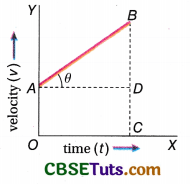
Along the time and the velocity axes, OC = t, OA = u and CB = v.
∴ a = slope of AB
= tanθ = \(\frac{D B}{A D}\) = \(\frac{C B-C D}{A D}\) = \(\frac{C B-O A}{O C}\) = \(\frac{v-u}{t}\)
Proof of v = u + at: We know the equation of a straight line of slope in with an intercept c on the y -axis is
y = mx + c ….. (1)
Comparing the corresponding values for AB [Fig.], we get, y = v, m = a, x = t and c = u.
∴ The graph AB follows the equation
v = u + at ….. (2)
Proof of s = ut + \(\frac{1}{2}\)at2: The area under the graph AB and the time-axis [Fig.], gives the displacement of the particle in time t.
Area under AB is the area of the trapezium OABC, which is the sum of the areas of the rectangle OADC and the triangle ABD.
Hence, the displacement of the particle in time t
s = OA × OC + \(\frac{1}{2}\)AD × DB = OA × OC + \(\frac{1}{2}\) × \(\frac{D B}{A D}\) × AD2
∴ s = ut + \(\frac{1}{2}\)at2 [∵ AD = OC = t] ……. (3)
Proof of v2 = u2 + 2as: From Fig., slope of AB = a = tanθ = \(\frac{D B}{A D}\) + \(\frac{D B}{O C}\)
∴ as = slope of AB × area of the trapezium OABC
= \(\frac{B D}{O C}\) × \(\frac{1}{2}\)(OA + CB) × OC
= \(\frac{1}{2}\)BD(OA + CB) = \(\frac{1}{2}\)(CB – CD)(OA + CB)
∴ as = \(\frac{1}{2}\)(v – u)(v + u) = \(\frac{1}{2}\)(v2 – u2)
∴ 2as = v2 – u2
or, v2 = u2 + 2as ….. (4)
Proof of s = u + \(\frac{1}{2}\)a(2t – 1): Let AP represent the Velocity-time graph [Fig.] of a particle starting with an initial velocity u and moving with a uniform acceleration a.
Let points D and E represent the times (t – 1) and t respectively in the motion. Hence, the area of the trapezium BCED denotes the displacement st in the t th second.

∴ st = \(\frac{1}{2}\)(DB + EC) × DE
From Fig.,
DE = OE – OD = t – (t – 1) = 1 s
DB = the velocity attained in time (t – 1)
= u + a(t – 1)
EC = velocity attained in time t = u + at.
∴ st = \(\frac{1}{2}\)[{u + a(t – 1)} + (u + at)] × 1
= u + \(\frac{1}{2}\)a(2t – 1) …… (5)
Derivation of the Equations of Motion Using Calculus
Derivation of y = u + at: From definitions acceleration is the rate of change of velocity
i.e., a = \(\frac{d v}{d t}\) or, dv = a dt
For motion with a uniform acceleration, a constant.
∴ ∫dv = a∫dt
or v = at + A [A = integration constant] …….. (1)
At t = 0, v = u. Then from equation (1), we get,
u = a.0 + A or, A = u
Hence, equation (1) becomes, v = u + at
Derivation of s = ut + \(\frac{1}{2}\)at2: know the velocity of a particle is the rate of change of its displacement with time.
∴ v = \(\frac{d s}{d t}\) or, \(\frac{d s}{d t}\) = u + at
or, ds = u dt + at dt,
a and u are constants.
∫ ds = u∫dt + a∫t dt
or, s = ut + \(\frac{1}{2}\)at2 + A [A = integration constant] ……… (2)
From initial condition, at t = 0, s = 0 ∴ A = 0
∴ Equation (2) becomes, s = ut + \(\frac{1}{2}\)at2
Derivation of v2 = u2 + 2as: Velocity of the particle, v = \(\frac{d s}{d t}\) and acceleration, a = \(\frac{d v}{d t}\) = \(\frac{d \nu}{d s} \cdot \frac{d s}{d t}\) = v\(\frac{d v}{d s}\)
or, a ds = v dv, where a is a constant.
a∫ds = ∫ v dv
or, as = \(\frac{u^2}{2}\) + B [B integration constant] …… (3)
At the start of motion, v = u and s = 0
∴ 0 = \(\frac{u^2}{2}\) + B or, B = –\(\frac{u^2}{2}\)
Substituting this in equation (3), we get,
as = \(\frac{v^2}{2}\) – \(\frac{u^2}{2}\)
or, v2 = u2 + 2as ….. (4)
Numerical Examples
Example 1.
s-t graph for a particle, moving with a constant acceleration, subtends 45° angle with the time axis at time t. That angle becomes 60° 1 s later. Find the acceleration of the particle. [HS ‘05]
Solution:
Let the velocity of the particle at P1 and P2 be u and v respectively [Fig.].
u = tanθ1 and v = tanθ2
∴ Acceleration of the particle

a = \(\frac{v-u}{t_2-t_1}\)
= \(\frac{\tan \theta_2-\tan \theta_1}{t_2-t_1}\)
= \(\frac{\tan 60^{\circ}-\tan 45^{\circ}}{1}\)
= \(\sqrt{3}\) – 1 = 0.732 unit ᐧ s-2.
Example 2.
Displacement x and time t, in a rectilinear motion of a particle are related as t = \(\sqrt{x}\) + 3. Here x is measured in metre and t in second. Find the displacement of the particle when its velocity is zero.
Solution:
Given, t = \(\sqrt{x}\) + 3 or, \(\sqrt{x}\) = t – 3 or, x = (t – 3)2.
Velocity, v = \(\frac{d x}{d t}\) = 2(t – 3)
If velocity = 0, 2(t – 3) = 0 or, t = 3 s
∴ At t = 3 s, the displacement, x = (3 – 3)2 = 0
Hence at zero velocity the displacement is also zero.
Example 3.
A body starts from rest and moves with an acceleration proportional to time.
(i) Find its velocity n s after starting.
(ii) What distance will It travel in n s?
Solution:
According to the problem, a ∝ t
or, a = kt, where k is the constant of proportionality.
Now, a = \(\frac{d v}{d t}\) ∴ dv = kt dt or, ∫ dv = k∫ t dt
∴ v = \(\frac{k t^2}{2}\) + A [where A = integration constant] …… (1)
Also, as v = 0 at t = 0, we get A = 0
∴ From equation (1) we get,
v = \(\frac{k t^2}{2}\) …. (2)
Again, if the displacement of the object is s, then v = \(\frac{d s}{d t}\)
∴ From equation (2),
\(\frac{d s}{d t}\) = \(\frac{k t^2}{2}\) or, ds = \(\frac{1}{2}\)kt2dt
On integration we get,
s = \(\frac{k t^3}{6}\) + B [where B = integration constant]
Also, at t = 0, s = 0 ∴ B = 0
∴ s = \(\frac{k t^3}{6}\) ….. (3)
At t = ns, from equations (2) and (3) we get,
- v = \(\frac{k n^2}{2}\) and
- s = \(\frac{k n^3}{6}\)
Example 4.
Velocity of a moving particle u decreases with its displacement. Given, u = v0 – αx where v0 = initial velocity, x = displacement and α is a constant. How long will the particle take to reach a point B on the x -axis at a distance xm from the origin?
Solution:
Given, v = v0 – αx.
At the starting point, v = v0.
∴ v0 = v0 – αx or, x = 0 [∵ α = constant]
Hence, the particle was initially at the origin.

Example 5.
The relation between the time taken and the displacement of a moving body is s = 2t – 3t2 + 4t3, where the unit of s is in metre and that of t is in second. Find out the displacement, velocity and acceleration of the body 2 s after initiation of the journey.
Solution:
Here, s = 2t – 3t2 + 4t3
∴ In 2 s the displacement of the body is,
s = (2 × 2) – [3 × (2)2] +[4 × (2)3]
= (4 – 12 + 32) = 24m
Now, the velocity is,
v = \(\frac{d s}{d t}\) = 2 – 6t + 12t2
∴ After 2s,
v = 2 – (6 × 2) + [12 × (2)2] = 38 m ᐧ s-2.
Example 6.
For a particle travelling along a straight line, the equation of motion is s = 16t + 5t2. Show that it will always travel with uniform acceleration.
Solution:
Here, s = 16t + 5t2
∴ Velocity, v = \(\frac{d s}{d t}\) = 16 + 10t
Again acceleration, a = \(\frac{d v}{d t}\) = 10 = constant
The particle will always travel with uniform acceleration.
Example 7.
If a, b and c arc constants of motion and s = at2 + bt + c then prove that 4a(s – c) = v2 – b2.
Solution:
Here, s = at2 + bt + c
∴ v = \(\frac{d s}{d t}\) = 2at + b
∴ v2 – b2 = (2at + b)2 – b2 = 4a2t2 + 4abt
= 4a(at2 + bt) = 4a(at2 + bt + c – c)
or, v2 – b2 = 4a(s – c) (proved).
Example 8.
The retardation a of a particle in rectilinear motion is proportional to the square root of its velocity v. Assume that the constant A of proportionality is positive. The Initial velocity of the particle is v0. How far would the particle move before coming to rest? What would be the time required to travel that distance?
Solution:

When the particle comes to rest after a time T, we have v = 0 at t = T. From (2),

When the particle comes to rest, v = 0. Then the total distance travelled is,
x0 = \(\frac{2}{3 A} v_0^{3 / 2}\)
Example 9.
The acceleration-time graph of a particle starting from rest is given in Fig. Draw the corresponding velocity-time graph and hence find out the displacement in 6s.

Solution:
In the intervals (0 → 1) (2 → 3) and (4 → 5) seconds, acceleration is zero, i.e., velocity = constant. Again, in the intervals (1 → 2), (3 → 4) and (5 → 6) seconds, the velocity increases uniformly and rises to 1 m/s, 2 m/s and 3 m/s respectively, because the uniform acceleration in each interval is 1 m/s2.

∴ The velocity-time graph of the motion is ABCDEF
Displacement in 6 s = area under ABCDEF
= area of 6 unit squares + area of 3 triangles
= 6 × (1 × 1) + 3 × (\(\frac{1}{2}\) × 1 × 1) = 7.5 m