Physics Topics are often described using mathematical equations, making them precise and quantifiable.
What is the System of Units?
A complete set of units which is used to measure all kind of fundamental and derived quantities is called a system of units. For defining the three basic units of length, mass and time the following systems have been used :
- centimetre-gram-second or CGS system (Metric system)
- foot-pound-second or FPS system (Imperial system)
- metre-kilogram-second or MKS system.
TABLE-2 lists the base units and TABLE-3 a few of the familiar derived units in the above mentioned systems. The FPS system is almost obsolete nowadays and will not be discussed here.
Table-2

Table-3

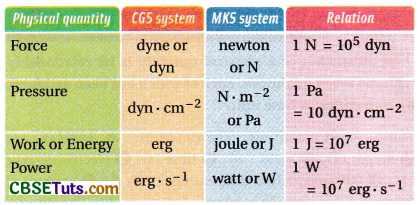
SI Units
If physical quantities are measured using different systems of units, the magnitudes would be different. It would become inconvenient to compare experimental results. Taking this problem into account, the International Bureau of Weights and Measures in their General Conference in 1960 introduced the International System of Units (SI). In addition to the base units of the MKS system, this system included units of
- temperature, kelvin or K,
- luminous intensity, candela or cd
- amount of substance, mole or mol and
- electric current, ampere or A as base units. In addition, the units of angle, (radian or rad) and solid angle, (steradian or sr) were called supplementary base units.
So, there were seven base SI units and two supplementary base units. But finally in 1995 the supplementary units were dropped and were called derived units. SI units provide an international standard of measurement and are used widely.
Table-4 below shows the base quantities and their corresponding SI base units.
Table-4

Symbol of units: Each unit is conveniently assigned a sign or a symbol by which it is represented. The exact method of symbolic representation of a unit follows some internationally accepted norms. The norms, with a few examples, are:
i) There is no dot (.) within the symbol or at the end.
Example: Centimetre: cm (not c.m or cm.)
However, if a sentence ends with a symbol then a full stop should be used to indicate end of the sentence.
ii) ‘s’ or ‘es’ is not to be used in a symbol to represent plural.
Example: 10 g but not 10 gs.
But if the symbol is written in words and the magnitude is more than 1 (one), plural form can be used.
Example: 10 metres per second or 1 metre per second is quite correct whereas 10 metres/s or 10 m/seconds is wrong.
iii) Symbols of units named after scientists should have only the first letters in capital.
Example: N for newton, A for ampere, Pa for pascal.
But if the name of the unit is written instead of the symbol, it should start with a small letter.
Example: newton, ampere, pascal.
The symbol of all other units start with lowercase letters. Example: m for metre, kg for Kilogram, dyn for dyne etc.
iv) The symbol of unit should be printed in regular font, not in italics. Even when the whole sentence is written in italics, symbols must be in roman.
In general, symbols of physical quantities are printed in italics, although there are exceptions.
Example: Representation of mass (physical quantity) : m (ital), but metre (unit) : m (roman).
v) Multiplication and division of units follow general algebraic rules.
Example: 10 m/s × 2s = 20 m; 20 m ÷ 2s = 10 m/s
vi) A space should be inserted between two adjacent symbols to indicate multiplication. However, the use of ‘ ᐧ’ or dot in that space is more common.
Example: N m or N ᐧ m. Again, to indicate division we can use the per or 7’ sign or the inverse power sign.
Example: J/(m2 ᐧ s) or J ᐧ m-2ᐧs-1 or \(\frac{\mathrm{J}}{\mathrm{m}^2 \cdot \mathrm{s}}\) is correct, but J/m2/s and J/m2ᐧs are wrong.
vii) It is improper to use a hyphen between the numerical value and the unit when the numerical value is used as an adjective. There should be a space between the numerical value and unit symbol except in the case of superscript units for plane angle.
Example: 16 -mm film is improper, but 16 mm film is proper.
viii) In thermometry, kelvin cannot be used with a degree (°) sign.
Example: 273 K, not 273°K; but the symbols °C, °F etc. are right.
ix) Sec, sq. mm, cc, mps are wrong uses. The correct repre-sentations are s, mm or square millimetre, cm or cubic centimetre and m/s or metre per second.
While dealing with very large or very small measurements, it is convenient to express them in powers of 10 . For example 100 and 1000 can be expressed as 102 and 103 respectively. Similarly \(\frac{1}{10}\), \(\frac{1}{1000}\) and \(\frac{1}{10000}\) can be expressed as 10-1, 10-3 and 10-4 respectively. These are called metric prefixes. Separate names are given to these prefixes and are listed in the following table.
Table-5
Prefixes for multiple and submultiple units in powers often
